
What is actually growing up there?
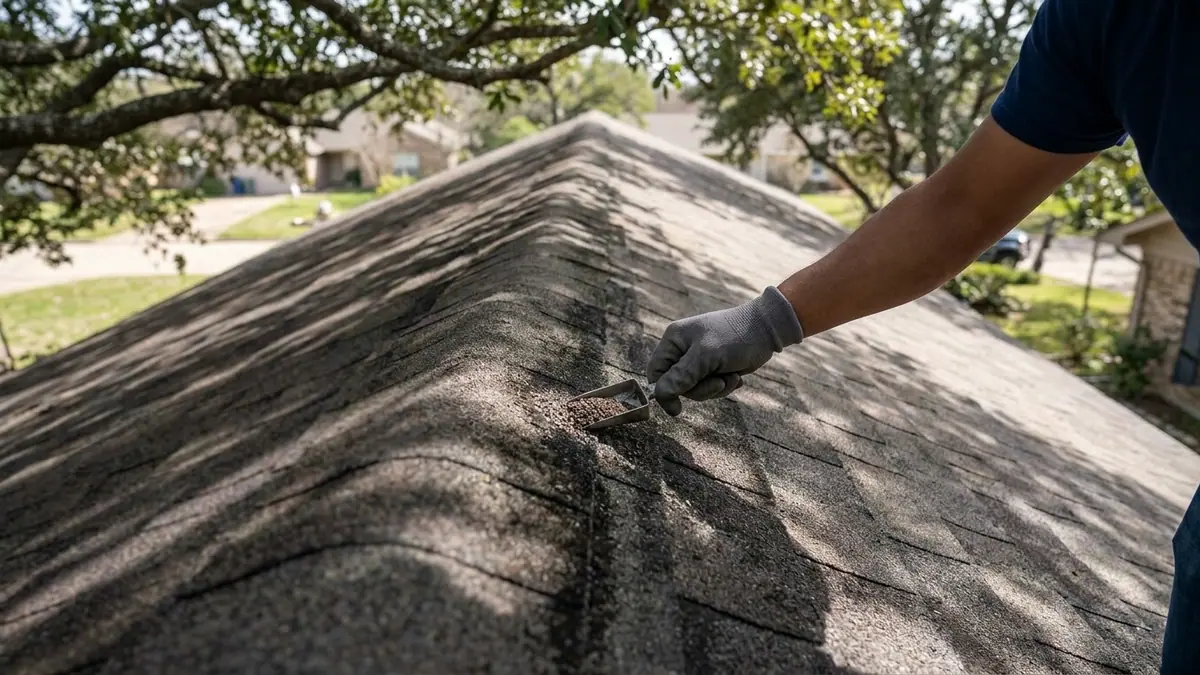
Gloeocapsa magma, a blue-green algae, is the predominant species behind dark blotches and streaks on asphalt shingles. It produces a dark pigmented sheath to protect itself from ultraviolet light, and that sheath is the black you see from the street.
Warm, humid conditions suit it, which describes Brenham's humid subtropical climate for most of the year. The algae feeds partly on the limestone filler in asphalt shingles, so a roof is a food source rather than just a surface.
Why the streaks run downward and sit on one side
Water carries it. Colonies establish near the ridge and wash down the slope with every rain, which produces the vertical striping rather than an even coating.
Shaded slopes go first. A north-facing plane, or any slope under the mature live oaks and pecans on older Brenham lots, dries slowly and stays damp longer after rain. The sunlit south slope on the same house often stays clean for years.
Is it damaging the roof?
Staining on its own is cosmetic. Staining plus granule loss is not. The algae itself does not eat through the mat, and a roof streaked black sheds water exactly as well as a clean one.
Two secondary effects are real:
- Heat absorption. A darkened slope runs hotter, and heat is what ages asphalt in this climate.
- Moisture retention. A colony holds damp against the covering on a slope that already dries slowly.
The combination that needs attention is streaking alongside bare black mat showing through. That means the granules have gone, and granules are the shingle's sunscreen.
What cleaning does and does not do
A correct wash removes the stain and does not stop it returning. The asphalt roofing manufacturers' guidance is unambiguous on method: low pressure and an appropriate cleaning solution, never a pressure washer.
Pressure washing an asphalt roof strips granules wholesale. It leaves the roof looking clean and takes years off its life in an afternoon, which is the worst trade available on a covering.
Expect regrowth. Cleaning is maintenance on a cycle, not a cure.
The fix that lasts
Algae-resistant shingles carry copper or zinc in the granules, which leaches slowly and suppresses growth. The biocide typically persists around ten years, and in some cases approaches fifteen.
That makes it a replacement decision rather than a repair one. A roof already streaked and near the end of its life gets the algae-resistant product at a full re-roof rather than a clean it will need again in two years.
Zinc or copper strips fitted near the ridge work on the same principle on an existing roof, washing biocide down the slope with each rain. Coverage falls off with distance from the strip, so a tall slope needs more than one run.
What a re-roof runs decides the rest, and a roof inspection settles the question the streaks raise, which is whether the covering underneath them still has service life worth protecting.