
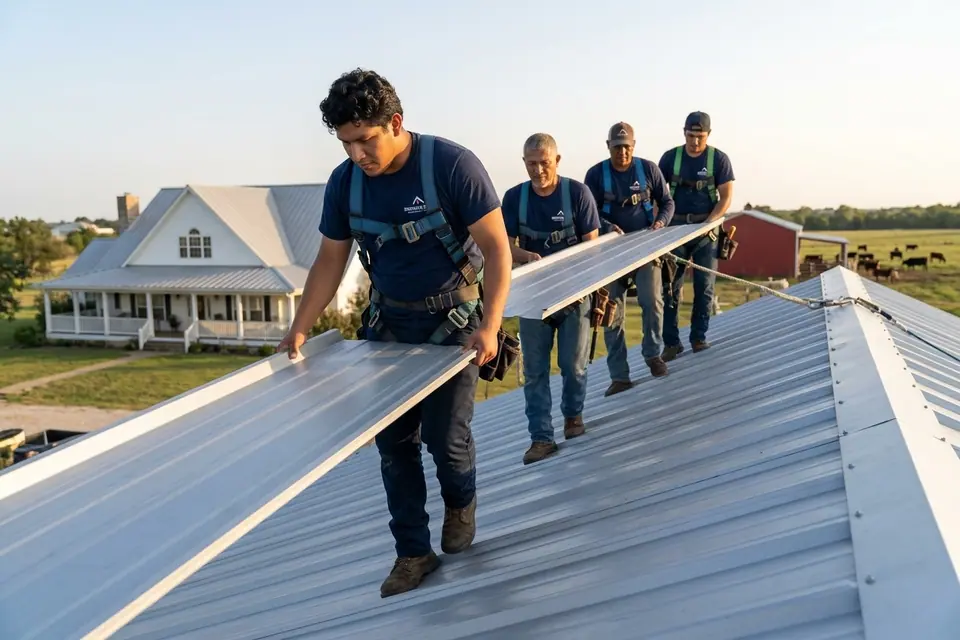
Replacing a Brenham roof
The tear-off and decking work under any new covering.
Metal on houses and outbuildings
Call (716) 328-9097 to reach a Brenham, TX roofer about metal roofing. Standing seam hides its fasteners under a folded seam and runs $8 to $14 per square foot installed. Exposed-fastener panel screws down over purlins at $7 to $12 and suits barns, shops and ranch outbuildings across Washington County. Both outlast asphalt by decades.
Calls answered 24/7
The table compares the two metal systems across cost, life, maintenance and the buildings each one suits.
| Attribute | Standing seam | Exposed-fastener panel |
|---|---|---|
| Installed cost per sq ft | $8.00–$14.00 | $7.00–$12.00 |
| Fasteners | Concealed clips under the seam | Screws through the face, with neoprene washers |
| Expected life | 40–60 years | 30–45 years |
| Maintenance | Seam and penetration checks | Washers harden and need replacing at 10–15 years |
| Thermal movement | Clips let panels expand and contract freely | Screw holes enlarge as panels move |
| Best suited to | Houses, visible slopes, historic district frontages | Barns, shops, equipment sheds, ranch outbuildings |
2026 Texas installed ranges. Gauge, coating grade, roof complexity and panel run length all move the figure inside each range.
The cost per year of service favors metal, and the upfront number favors asphalt. Standing seam at $11 per square foot over 50 years costs about $0.22 per square foot per year. Architectural asphalt at $7 over 22 years costs about $0.32.
That arithmetic holds only for an owner who stays. A household planning to move within a decade recovers the premium through resale value rather than service life, and resale credit for a metal roof varies by buyer.
Brenham's climate favors metal on a second count. Long hot summers and no sustained snow load mean the failure mode here is UV and heat, which metal resists and asphalt does not. The full comparison sits in metal or shingle on a Washington County property.
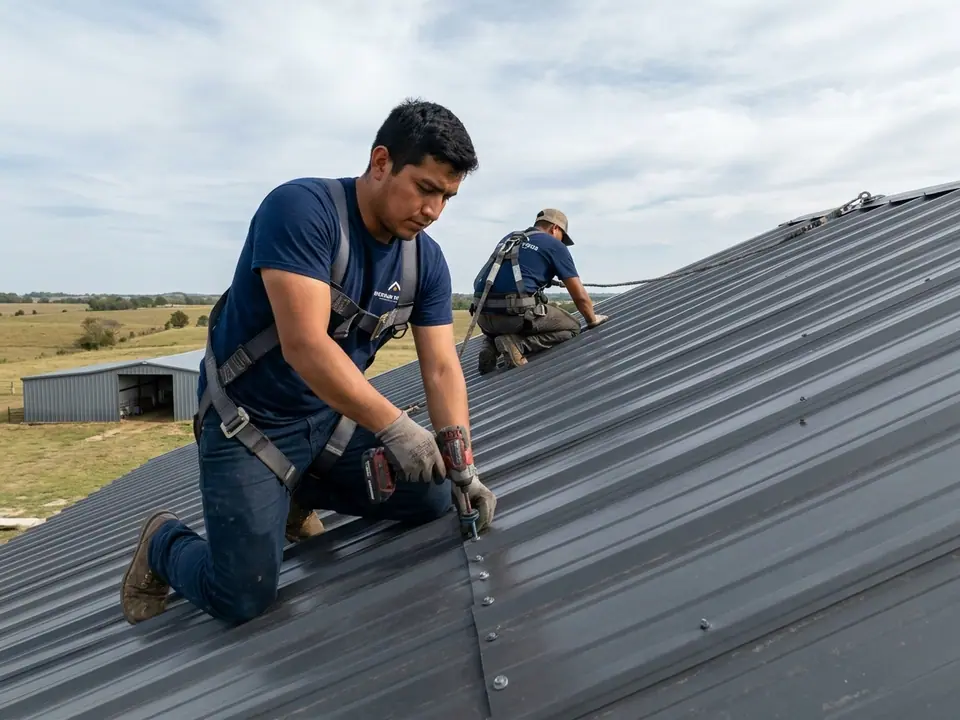
Metal fails at details, never in the field. These are the details.
A 30-foot steel panel moves roughly a quarter inch between a January night and an August afternoon. Clips accommodate that; rigid screws fight it.
High-temperature synthetic underlayment belongs under metal. Standard felt cooks and degrades against a hot panel.
Pipes and vents through a metal roof need purpose-made boots rated for the panel profile and the heat.
An overdriven screw crushes its washer and leaks within a season. An underdriven one never seals at all.
Panel over purlins suits an outbuilding. Panel over solid decking on a house cuts noise and adds stiffness.
Copper against steel, or the wrong fastener alloy, sets up galvanic corrosion at every contact point.
Three routes, and the right one depends on what is underneath.
The honest route on a house. The decking gets inspected, repaired and re-underlaid before panels go on.
A barn or shop frame takes purlins directly. No decking, no underlayment, and the cheapest square footage on the property.
Legal in many jurisdictions and rarely wise. It traps a layer of heat and hides whatever the old covering was doing to the deck.
Panel over solid decking with underlayment sounds close to asphalt from inside the house. The drumming people remember comes from panel over open purlins on a barn, with nothing between the steel and the air below it.
No. Metal roofing does not increase the chance of a strike. A strike that does arrive gets conducted and dispersed by the panel rather than igniting it, which makes metal a lower fire risk than asphalt in that scenario.
Exterior work inside Brenham's historic preservation district needs a Certificate of Appropriateness, judged against the city's adopted design guidelines. Standing seam has a long precedent on Texas historic buildings. Take the panel profile and color to the review before ordering.
Steel panel dents at that stone size and keeps shedding water. Asphalt at the same size fractures its mat and loses years of life. Dents are cosmetic on a metal roof, which changes how a hail claim on metal gets valued.
26 gauge is the working standard for agricultural panel in Texas, and 24 gauge is the heavier upgrade. Thinner 29 gauge panel costs less per square and oil-cans visibly across long runs on a wide span.
Call to reach a Brenham roofer and get both coverings quoted on the same roof.
Calls answered 24/7
The tear-off and decking work under any new covering.
Every covering and repair, priced side by side.
Fastener, washer and seam repairs on existing panel.