
Late winter: the pre-season check
Book the annual inspection before spring, because Washington County's severe weather clusters in spring and early summer on the National Weather Service record. A dated photographic report made in February establishes the roof's condition before the season that tests it.
That record is what turns an August claim from an argument into arithmetic. Without it, a homeowner and a carrier are trading opinions about what a slope looked like six months earlier.
Check from the ground at the same time: granules collecting at the downspout outlets, lifted tabs along the rake, and any daylight visible at penetrations from inside the attic.
Spring and early summer: after every storm
Walk the perimeter after any event that brought hail or sustained wind, and photograph what you find before clearing it. The county recorded 17 thunderstorm wind events and six hail events between 2016 and 2026, with gusts measured to 65 mph.
Where the event opens the covering, emergency cover comes first. At those speeds the damage is usually a broken seal strip rather than a missing shingle — the tab stays put and stops bonding, which is invisible from the driveway and fails in the next storm. That is the case for having someone walk it rather than judging from below.
Summer: the heat months
August is when a poorly ventilated attic does its damage. Nothing on the roof needs touching in the heat, and two things inside are worth watching:
- The HVAC condensate line and pan, which run hardest now and cause more ceiling stains in a Texas summer than the roof does.
- Attic temperature and airflow, where blocked soffit intake shows up as an attic that never cools after sunset.
Staying off the roof matters here too. Asphalt softens in full summer heat and foot traffic scuffs granules off a hot covering.
Autumn: debris and drainage
Clear the valleys before the gutters. Oak and pecan drop fills a valley within a season on an older Brenham lot, and a packed valley dams water back under the covering where a packed gutter merely overflows.
Then the troughs and the downspout discharge. Water dumped at the wall lands on Blackland Prairie clay that swells and shrinks with moisture, which is a foundation problem before it is a roof one. Gutter work is worth doing before the winter rain rather than after it.
Winter: the occasional freeze
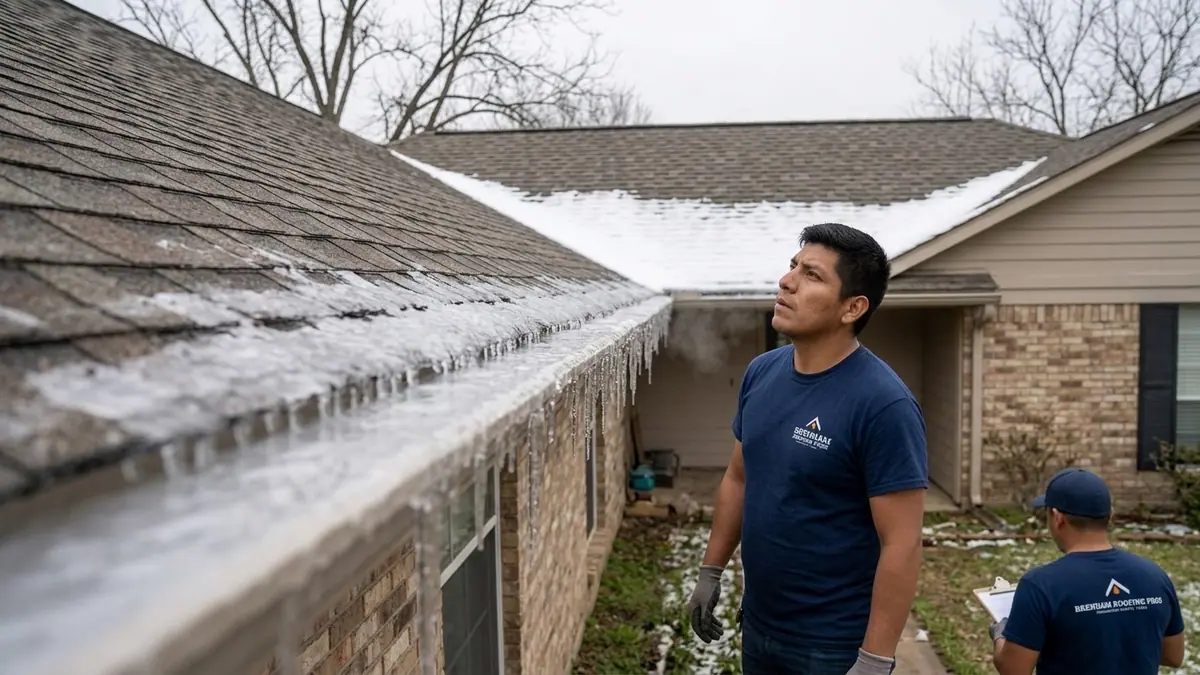
Check the penetrations and the eave line in the first dry week after any freeze event. Sealants contract in cold and open hairline gaps; meltwater refreezing at a cold eave backs water uphill under the covering.
Freeze damage announces itself weeks later at the next heavy rain, which is why the connection gets missed. A short walk in the dry window afterward ties the two together.
The one job to book
Everything above is a ground-level check except the annual walk. That one gets a dated condition report with photographs attached, slope by slope, and it is the document every later conversation with a carrier or a buyer depends on.