
What is under a Washington County house?
Clay, and a lot of it. The Texas State Historical Association places Washington County in the Blackland Prairies region of southeast central Texas, with shallow to deep clayey soils over a bed of chalk across most of the county, and brownish to reddish cracking clayey or loamy soils along the Brazos.
Blackland Prairie clay is smectite, the most reactive common clay in Texas. It takes on water, swells and lifts. It dries, shrinks and drops. A dense clay pan sits only a few feet down across the region and passes water slowly, so what soaks in stays near the surface rather than draining away.
A slab foundation sitting on that material moves with it. Roof water is the largest single volume of water a homeowner actually controls.
How much water is a roof shedding?
More than 1,200 gallons per inch of rain on a 2,000 square foot roof. Brenham rainfall arrives in bursts rather than evenly, and a single thunderstorm cell drops an inch in under an hour.
Without gutters, that volume lands in a narrow strip along the drip line, at speed. The soil directly against the wall goes from dry to saturated in minutes, which is exactly the swing that moves clay.
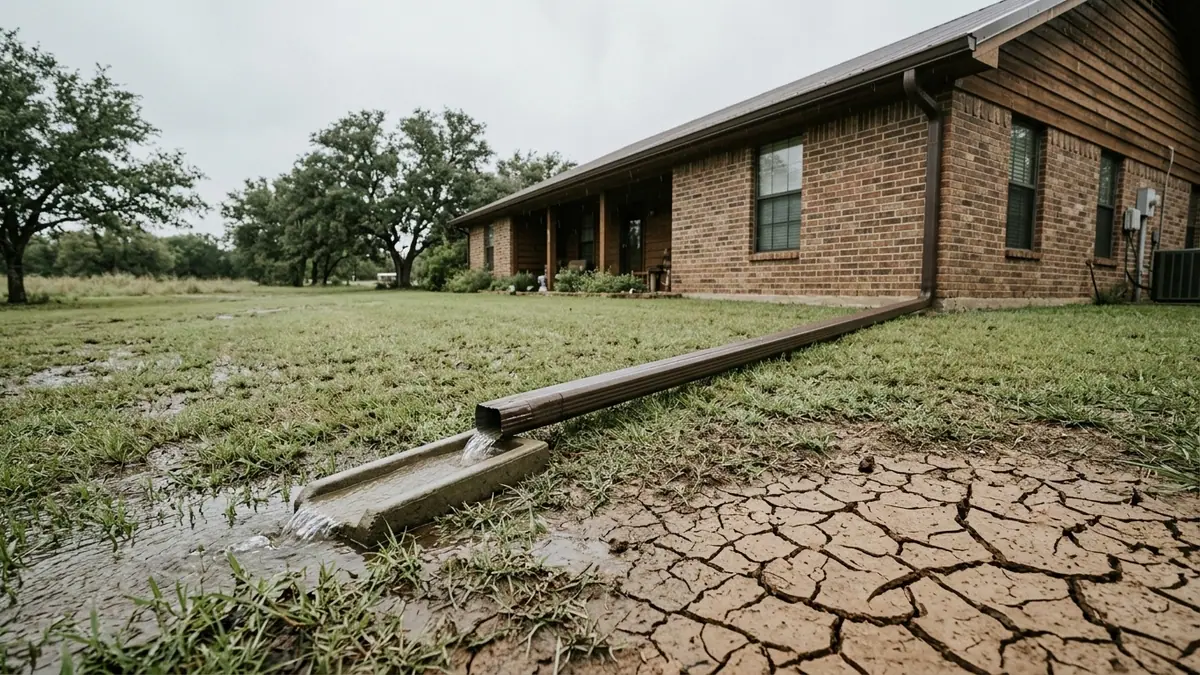
Where the water has to end up
Far enough from the wall that the soil under the slab keeps a steady moisture content. Three details do the work, and two of them cost almost nothing:
- Trough sized to the roof area feeding it. Five-inch handles most single-story runs; six-inch belongs under steep slopes and large drainage areas. The deciding number is the square footage draining into the run, not the size of the house.
- One downspout per 30 to 40 feet of trough, positioned away from doors, walkways and the low corner of the lot.
- Discharge carried clear. A downspout ending at the foundation concentrates the entire roof's runoff into one spot of reactive clay. An extension of several feet onto graded fall moves it off the problem.
The third is the one most often skipped, and it is the one that matters most here.
What a failing gutter does on clay
A trough packed with pecan and oak debris holds water against the fascia and overshoots in heavy rain. From the ground it reads as a gutter problem. Under the slab it is a soil-moisture problem, because the overshoot lands in the same narrow strip a bare drip line would have created.
Fascia rot follows the same water. Wood held wet loses its nail hold, the hangers pull away, and the run starts to sag — which changes the fall and makes the overshoot worse. The board gets replaced with the gutter rather than after it, and seamless gutter work is priced that way.
The check to run after heavy rain
Walk the perimeter while the roof is still draining. Look for water sheeting off the trough edge, a downspout discharging straight at the wall, and ponding within three feet of the foundation. Each one has a fix measured in feet of extension rather than in thousands of dollars. A slope-by-slope check catches the rest.
Water getting behind the trough instead of into it points at missing drip edge metal, and that is a roofing detail rather than a gutter one. Where it has already reached the sheathing, leak tracing comes before any new trough goes up.