
How long does a roof last in Brenham's climate?
Architectural asphalt returns 18 to 25 years here, and 3-tab returns 12 to 18. Brenham's climate is humid subtropical, with long hot summers and no sustained snow load, so heat and ultraviolet exposure are what age a covering rather than freeze-thaw cycling.
Attic ventilation decides where a roof lands inside that range. A covering over a poorly vented attic cooks from below and loses years. The same shingle over balanced soffit intake and ridge exhaust reaches the top of its range.
The five readings
1. Age against the rated life. Past 75% of the rated life, money spent on patching is money spent twice. A 20-year covering at year 16 with storm damage is a replacement conversation.
2. Granule loss. Granules are the covering's sunscreen. Bare black mat showing through, and granules piling at the downspout outlets, mean the asphalt beneath is exposed and hardening.
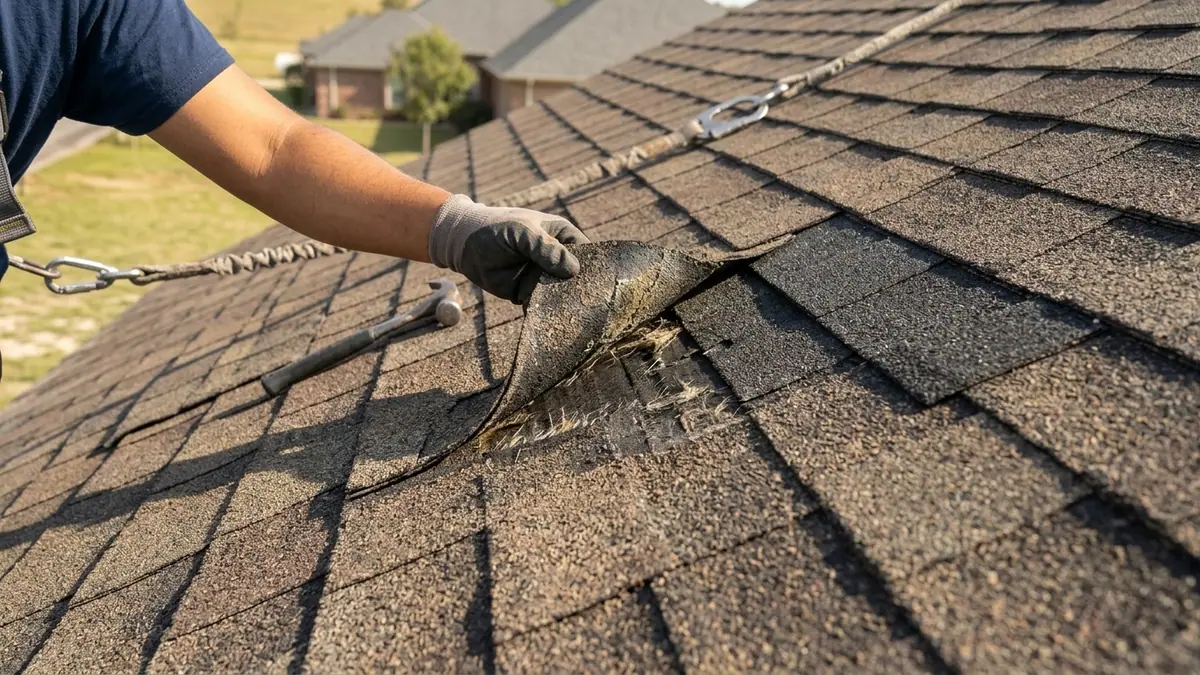
3. Seal strip condition. A tab that lifts by hand with no resistance has lost its bond. Scattered failures are a repair. Failures across a whole slope are a covering that will keep shedding tabs in every storm.
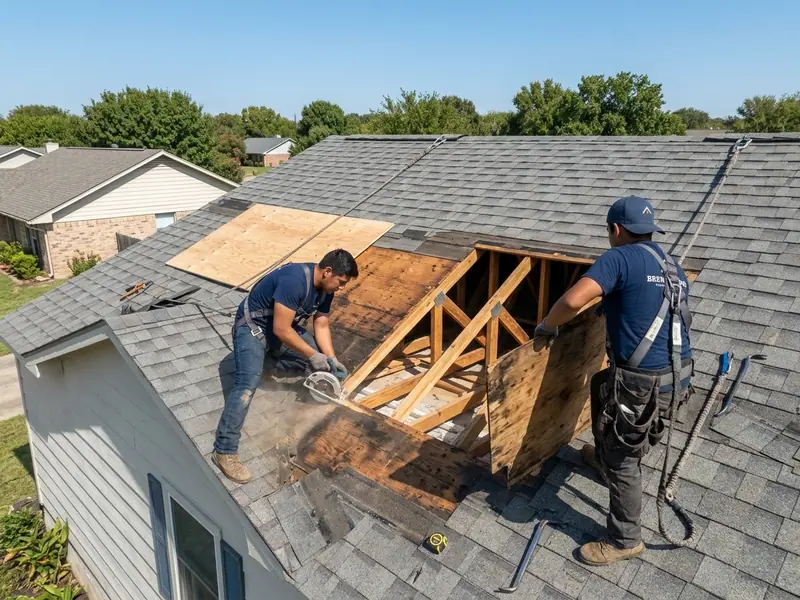
4. Decking feel underfoot. Sponginess between rafters means sheathing that has taken water and lost its nail hold. A soft patch is a repair; softness across a slope is not.
5. Repair history. Three patches in four years on different slopes says the covering is failing across the board and the leaks are arriving in sequence.
What about matching shingles on an older roof?
Exact match on an aged Texas roof is not achievable. Sun lightens asphalt within a few seasons, so new tabs read darker for a year or two before they weather in. Manufacturers also discontinue color blends, and a covering more than a decade old is often out of production entirely.
That does not rule out a repair. It means a repair on a street-facing slope will be visible, and a repair on a rear slope will not. Spare bundles left in the garage from the original installation close the gap where they exist.
When does insurance change the answer?
A covered claim reprices the decision entirely. Storm damage that a carrier accepts moves the cost of a replacement to the deductible, which on a Texas wind and hail policy runs one to two percent of the dwelling value.
At that point, a 16-year-old covering with accepted damage is a straightforward replacement, while the same roof without a claim is a harder call. Dated photographs of the roof's condition before the storm are what separate a paid claim from a denied one, which is the argument for an annual inspection in this county.
The decision, in one line each
- Repair: damage confined to one area, covering under three-quarters of rated life, decking sound.
- Replace: wear on every slope, seal strips failing widely, repeated repairs, or decking soft in more than one place.
Either way, the scope belongs in writing before anything comes off. The price ranges for both are in the Brenham roofing cost guide, and what a full replacement involves is set out step by step.