
What does a general home inspection miss?
Everything that is not the house, and most of the detail on the house itself. A general inspector covers an entire dwelling in a few hours, rarely walks a steep covering, and reports the roof in summary. Outbuildings usually fall outside the scope entirely.
On a rural Washington County tract that gap is the majority of the roof area on the property. Outside the city limits you find ranchettes of 5 to 20 acres, and a working place carries a barn, a shop and often an equipment cover in addition to the house.
What to have looked at, structure by structure
Each building gets its own assessment, because each has its own assembly and its own remaining life.
- The house. Covering age, granule loss, seal-strip condition, flashing at every penetration, and the attic underside for staining and ventilation.
- The barn. Panel gauge, fastener and washer condition, closure strips at eave and ridge, and rust at the laps and cut edges.
- The shop or garage. Usually the newest roof on the place and the easiest to read.
- Equipment covers and lean-tos. Open structures take wind hardest because there is nothing underneath to slow it.
Age matters differently per structure. A 20-year asphalt roof on the house is a replacement conversation. A 20-year steel panel on the barn is mid-life.
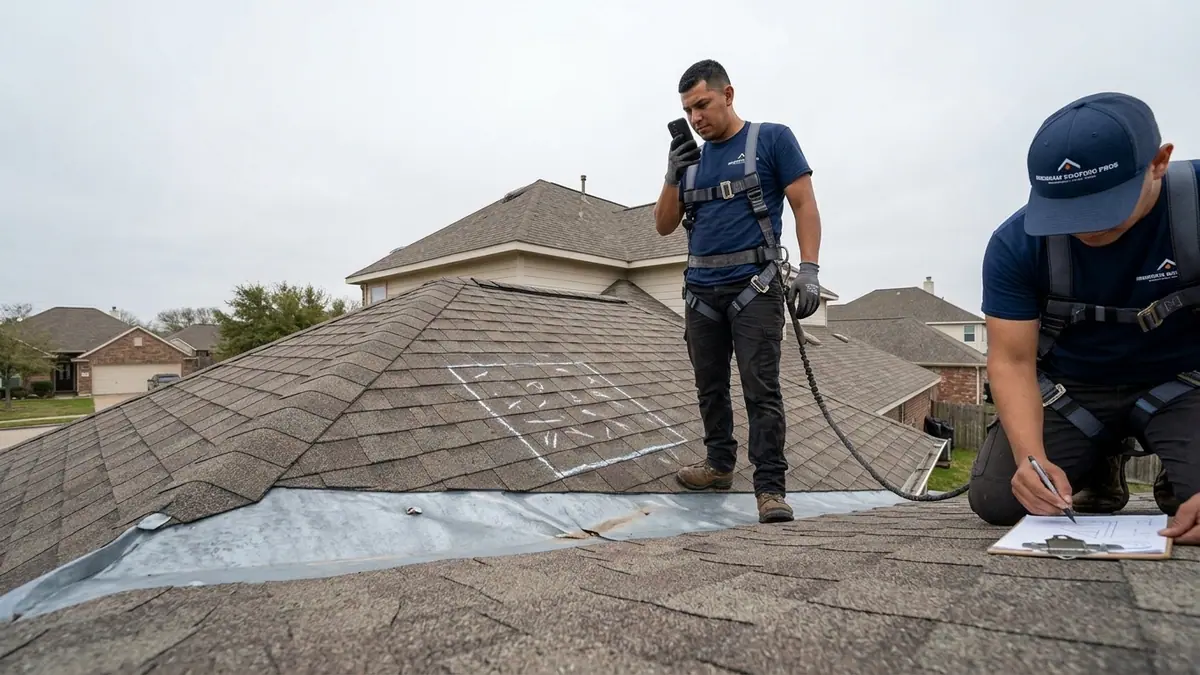
Why the dated photographs matter to a buyer
A photographic record made before closing fixes the roof's condition on a known date. Without it, damage found in the first spring after purchase is an argument about whether it predated the sale.
The argument matters in two directions. A carrier deciding a storm claim asks what the roof looked like before the storm. A buyer negotiating a price reduction needs specific defects with images attached rather than a one-line verdict.
Washington County's severe weather clusters in spring and early summer on the National Weather Service record, so a place bought in autumn faces its first real test months after the keys change hands.
What to do with what the report finds
Price the work, then decide whether it moves the offer or the closing date. Three outcomes are normal:
- Maintenance items — a failed pipe boot, a lifted ridge cap, hardened washers on the barn. These are targeted repairs in the hundreds, not a reason to walk.
- A covering near the end of its life. Quantifiable, and the number belongs in the negotiation rather than in a vague concern about age.
- Deck damage. Soft sheathing under an old covering is the one that escalates, because it is found only when the old roof comes off and is priced per sheet.
Timing against the option period
A Texas option period is short, and roofing schedules are not. Book the inspection the day the option starts rather than at the end of it, and ask for the report in writing with the images attached.
A roofer quoting the work can inspect it at the same time, and a written condition report on every structure costs a fraction of what a surprise on the barn costs after closing.