
Why nobody can quote it accurately
The decking is under the roof, and the roof has to come off to see it. A contractor standing on the covering feels obvious soft spots underfoot and misses the rest, which is the limit of a pre-tear-off assessment. Water damage spreads along a sheet from a single failed penetration, and the sheet looks sound from above until the shingles are stripped.
That is the whole reason a replacement is quoted as a scope. A flat price with no decking language either builds in a large contingency, or it becomes a change order on the second day.
What the allowance has to name
A number of sheets included, and a per-sheet rate beyond it. For example: four sheets included, then a stated dollar figure each. Both halves matter — an allowance with no rate leaves the price of sheet five open.
Three details belong alongside it:
- Sheet size and thickness, so the replacement matches what is there.
- Who decides a sheet is bad, and whether you get photographs of each one before it is replaced.
- Re-nailing of sound sheathing, which is separate work and often skipped silently.
Ask for the photographs. A dated image of each condemned sheet before it comes out is how an allowance stays honest.
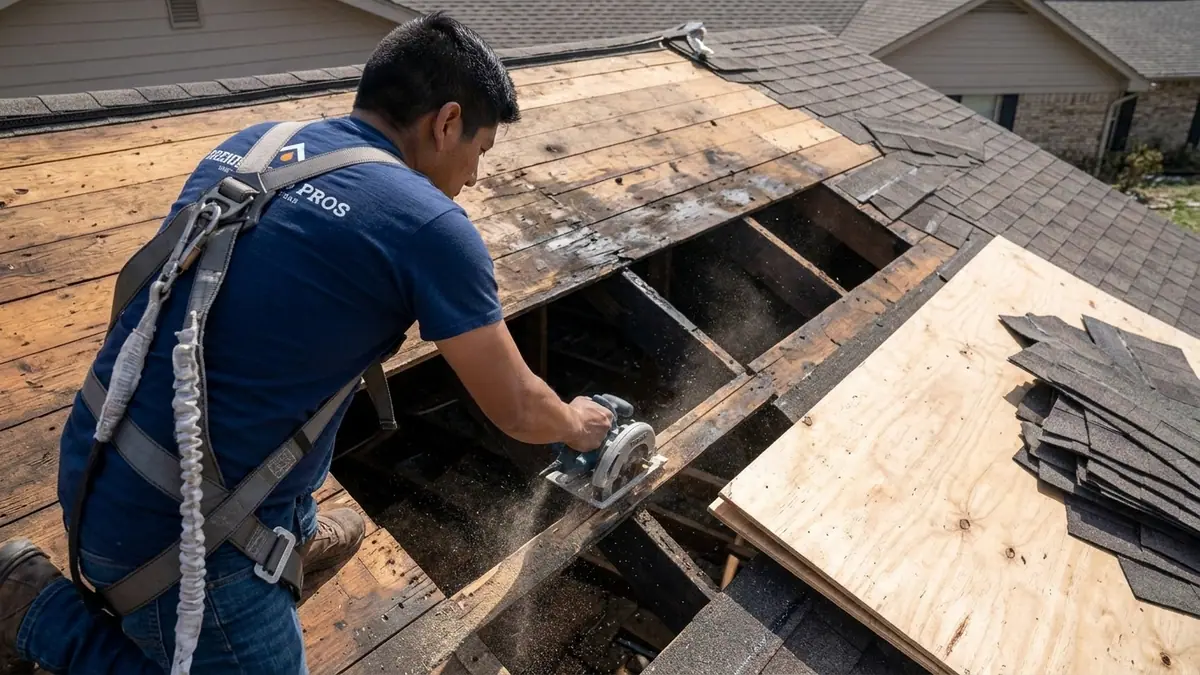
What makes decking fail in Brenham
Water that sat, and heat that never left. Four patterns account for most of it locally:
- A failed pipe boot dripping onto the same square foot for two or three years.
- A packed valley damming water under the covering after oak and pecan debris builds up.
- A limb strike fracturing a panel without tearing the shingles above it.
- Attic condensation in a poorly vented roof, which wets the sheathing from below across a whole slope rather than at one point.
The last one is the expensive version, because it is not localized. A roof where the deck is damp underneath everywhere is a ventilation failure that a new covering alone does not fix.
Plywood, OSB and what goes back
Replacement matches the existing deck thickness and the rafter spacing it spans. Mixing a thinner sheet into an older deck leaves a step under the covering that telegraphs through the finished shingles.
Older Brenham houses turn up plank decking rather than sheet goods — individual boards with gaps between them. Shingling over gapped planks needs an overlay sheet, and that is a scope decision with a real cost, not a detail to discover mid-job.
Why it is worth the attention
Decking is the difference between two quotes that look identical. A contractor including zero sheets is cheaper on paper and more expensive on the final invoice, and the homeowner has no leverage once the roof is open and the sky is showing.
The Brenham cost guide carries decking sheet replacement at $500 to $2,500 as its own line for exactly this reason, and the replacement sequence puts the deck assessment before any new material goes down.