
What the code actually requires
Underlayment under asphalt shingles has to conform to ASTM D226 Type I, ASTM D4869 Type I or ASTM D6757. Those standards sit in section R905.2 of the 2021 International Residential Code, which the City of Brenham adopted in Chapter 6 of its ordinances.
The quantity changes with slope. A roof at 4:12 or steeper takes a single layer. Below 4:12, the code requires two layers with minimum two-inch laps and end laps offset by at least six feet.
The three products
Felt is the traditional asphalt-saturated paper, sold in 15 and 30 pound weights. It is cheap, it tears in wind, and it wrinkles when it gets wet before the covering goes on.
Synthetic is a woven polymer sheet. It is lighter, far stronger in tear, lies flat, and stays walkable when damp. It has become the working default on a properly quoted Texas job.
Self-adhered membrane, often called peel-and-stick, bonds to the deck and seals around the nails driven through it. It costs several times what synthetic does per square, which is why it goes where it earns its place rather than across the whole roof.
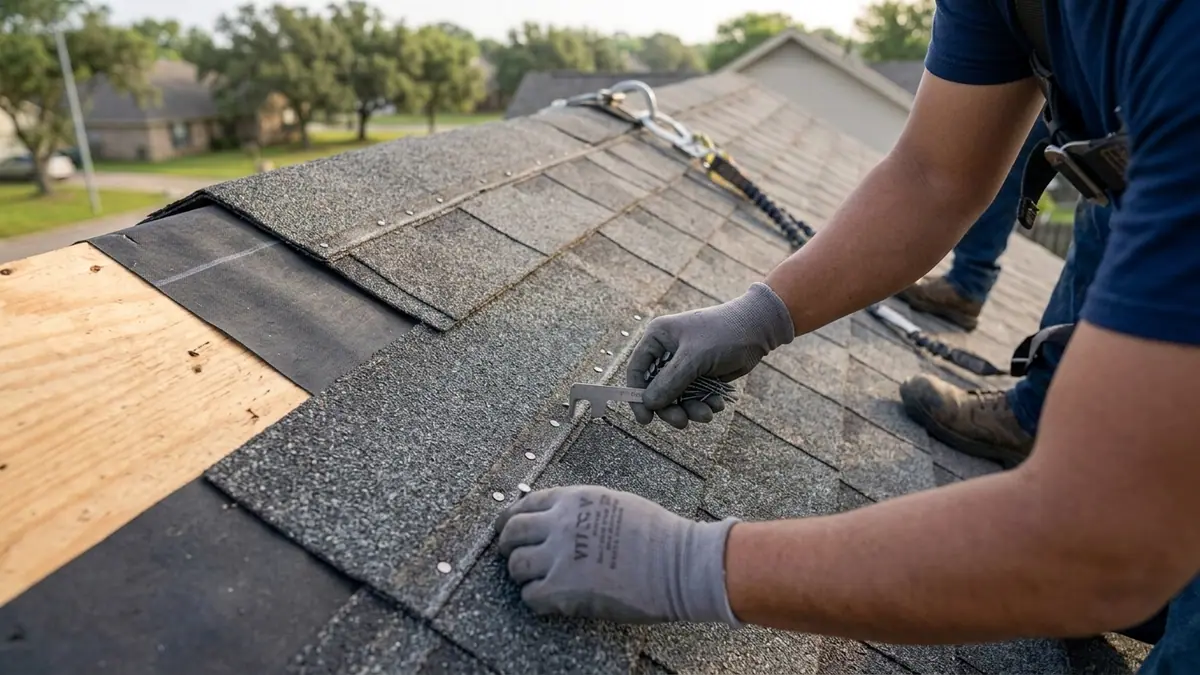
Where the expensive membrane belongs
In the places water concentrates or backs up. On a Brenham roof that means:
- Valleys, where two slopes push their water into one channel.
- Eaves, where wind-driven rain pushes uphill under the first courses.
- Around every penetration — pipe boots, skylight curbs, chimney bases.
- Along wall junctions, behind the step flashing.
- Low-slope sections, porches and additions where the water moves slowly.
A quote that lists synthetic across the field and self-adhered membrane at those points is a correctly specified roof. A quote that says only "underlayment" is a quote with room to substitute felt after the contract is signed.
Metal needs a different product
High-temperature synthetic underlayment belongs under metal panel, and standard felt does not. A steel panel in Texas sun reaches temperatures that cook ordinary felt, which then degrades and turns brittle against the deck.
The high-temperature grades are rated to withstand it, and the rating is printed on the roll. Ask to see it on a standing seam or panel job, because this is a failure that shows up years later and looks like a mystery leak when it does.
Why it is worth arguing about
Underlayment is invisible once the covering is on. That makes it the first thing a low bid downgrades, and the homeowner has no way to check after the fact.
The consequence is not immediate. It arrives the first time a wind event lifts tabs on one slope, or a valley dams with pecan debris and water sits. At that moment the underlayment is the entire roof, and felt that has wrinkled and torn is not a second line at all — it becomes the leak it was meant to stop.
Get the product name and the coverage map into the written replacement scope alongside the decking allowance. Both are line items a quote can hide, and both decide what the roof does under stress.