
What does the county record actually show?
Falling timber, repeatedly. The National Weather Service logged 17 thunderstorm wind events in Washington County between 2016 and 2026. The single tornado on that record, an EF0 near William Penn Road on 26 May 2016, is described as downing numerous trees, several uprooted, with $10,000 in reported property damage.
The strongest measured gusts in the period were 65 mph, near Washington in May 2020 and near Wesley in May 2024. Those speeds rarely strip a roof outright. They break limbs.
What a limb strike does that a shingle hides
The shingle absorbs the blow and the deck takes the damage. A branch that bounced off a slope and rolled into the yard leaves a bruised, sometimes cracked sheathing panel under a covering that reads intact from the driveway.
Three things follow, in order:
- Fractured decking loses its nail hold around the impact, so the shingles above it lift in the next wind.
- Cracked shingle mat passes water long before the tab itself tears.
- Compressed insulation under the impact point shows up later as a cold spot and a condensation stain.
Walking the slope and pressing it is what finds this, and decking repair after a strike is priced by the sheet. Nothing about it is visible from a photograph taken at ground level.
What overhanging branches do the rest of the year
A limb that never falls still costs the roof service life. Four mechanisms, none dramatic:
- Abrasion. A branch resting on the covering scours granules off every time the wind moves it.
- Shade and damp. A permanently shaded slope dries slowly and holds moisture against the covering in a humid climate.
- Debris load. Pecan and oak drop fills valleys and gutters within a season, and a packed valley dams water back under the covering.
- Access for pests. Branches touching the roof are a bridge to the fascia and the attic.
Clearing the gutters is the visible half. The valleys matter more, because that is where two slopes concentrate their water into one channel, and gutter and drainage work only helps once the valley is running clear.
When trimming is the cheaper repair
Where limbs sit within about ten feet of the roof, trimming costs less than one storm's decking repair. That is arboriculture rather than roofing, and the sequencing matters: trim first, then re-roof, so the new covering is not scoured during the tree work.
Heritage oaks complicate it. A tree worth keeping gets trimmed rather than removed, and a roof under one gets inspected more often instead. Cutting a mature live oak to protect a roof is usually the wrong trade on a Brenham lot.
After a limb comes down
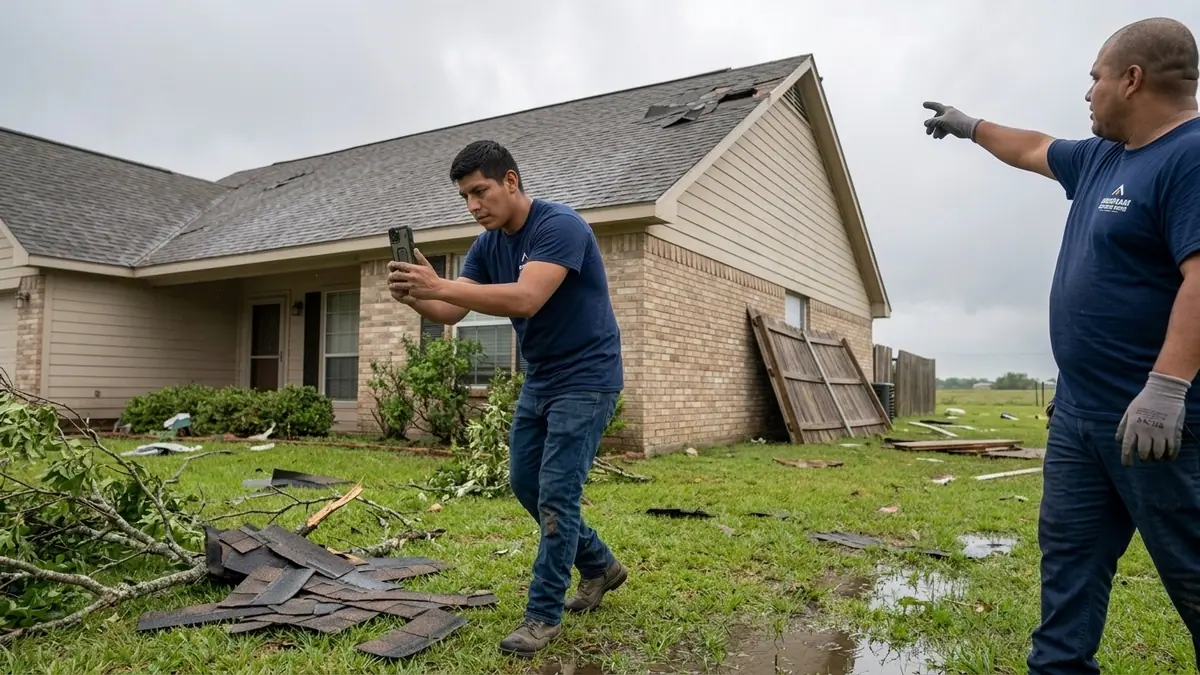
Photograph it where it landed, before anything is moved. The limb on the slope, the debris line in the yard, and the damage underneath once it is lifted. Those images date the event and separate it from wear.
Then get the opening covered. Emergency tarping is priced as its own visit and it protects the claim as well as the ceiling, which is where storm damage work properly starts.